

Wine trail
Wine trail of the town of Hofheim am Taunus
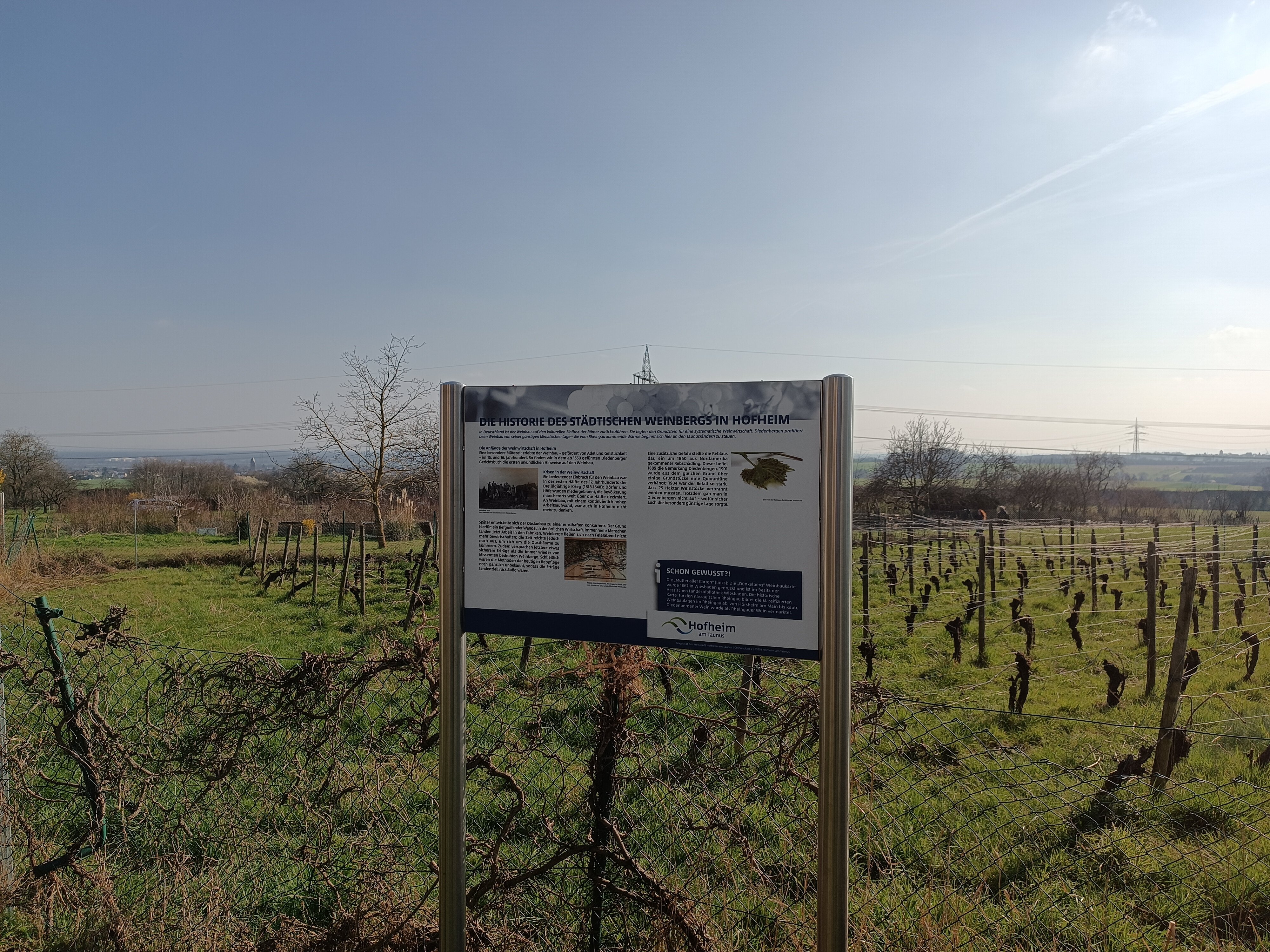
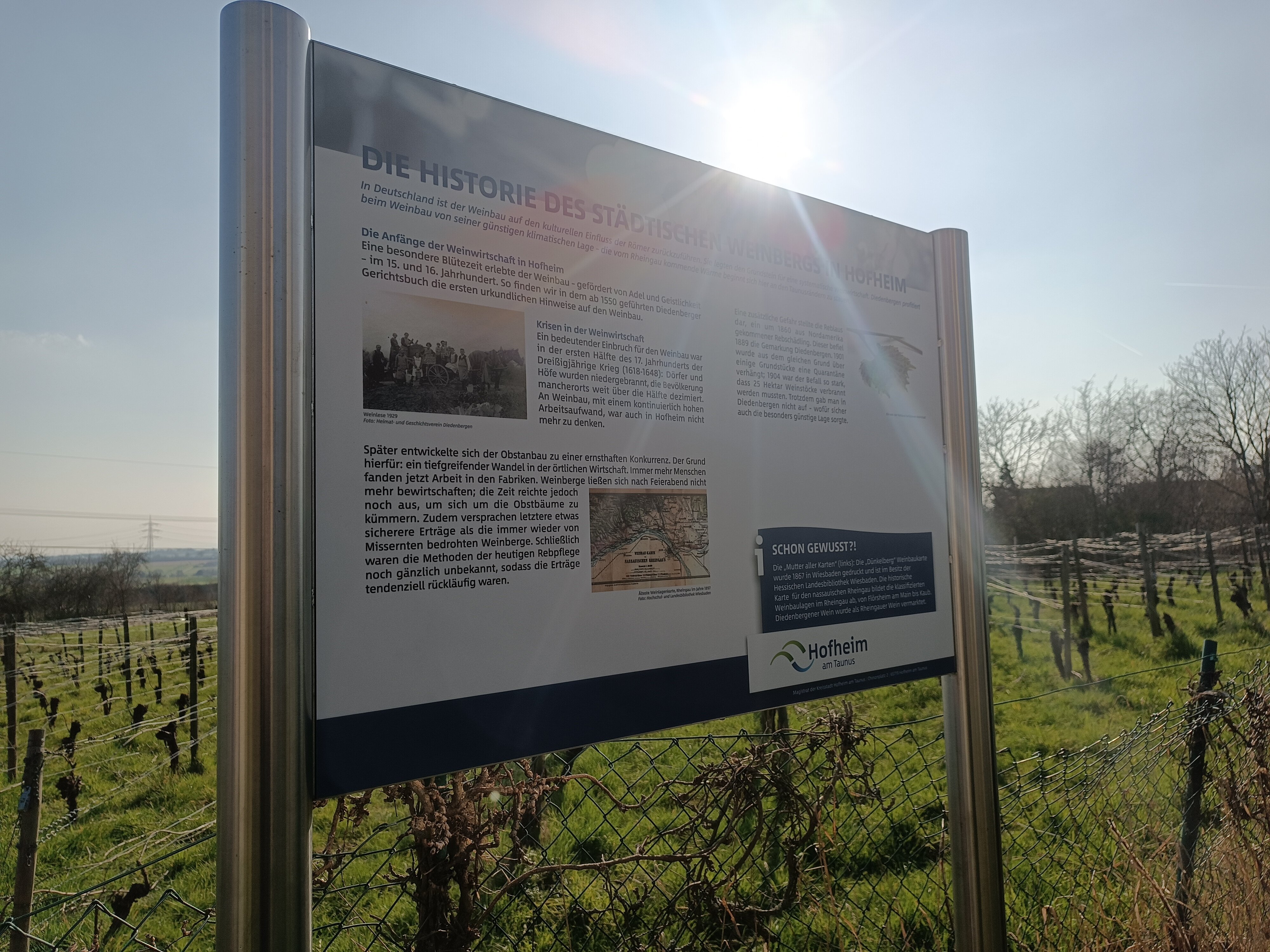
On September 28, 1997, a small educational wine trail was inaugurated along the vineyard, which was designed by the "Diedenbergener Malkreis 1977". It showed the work of the winegrower throughout the year on eight panels. In 2023, the information boards were revised and replaced in spring 2024 by six large, new educational boards along the educational trail. The individual steps of a winegrower's work are still presented here, as well as the history of the vineyard and the annual wine labels of the "Diedenbergener Sonnenhang" since 1994. The municipal vineyard is located in the Diedenbergen district and can be reached via Casteller Straße (junction Schwarzwaldstraße / Am Bräunling).
If you wanted to describe the hard work of the winegrower, it used to be said that he had to "walk" around each vine at least 17 times in a year. Only then could he begin the harvest. Even today, there are still numerous operations in the vineyard.
It usually begins in January/February with pruning. The old vine wood is cut back to one or two strong fruiting canes. The vine loses about 90 percent of its wood in the process. This pruning is carried out in order to regulate growth, yield and quality according to the location. In the past, the pruned wood was bundled during the so-called sweeping of the vineyards, carried out of the vineyard and burned. Today, it is left in the vineyard and mulched in spring so that it remains in the vineyard as humus.
The canes are harvested in February/March. In the half-arch training method used here in the urban vineyard, they are bent over the upper trellis wire and tied to the lower trellis wire. This gives the vines support and encourages all the buds to sprout evenly.
During the growth phase of the vines, soil cultivation is necessary to regulate the water and air balance of the soil and to limit the growth of weeds. Depending on the weather and soil conditions, the soil is loosened or the overgrowth between the vines is mowed and mulched. During the dormancy of the vines in winter, open soils are avoided in order to prevent nutrient leaching. For this reason, the vegetation in the vineyard is only mulched from August onwards.
Every year, the vine draws nutrients from the vineyard. A young vine needs additional nutrition to build up its trunk and root system. This is the purpose of fertilization, which is applied according to the results of soil sample analyses and at the time of need. This avoids over-fertilization and unnecessary nutrient leaching.
The foliage work begins around May . Stingy shoots are removed from the vine trunks, the movable staple wires are first laid down and - as soon as the vine shoots are large enough - put back into their anchors at the top of the stakes. In this way, the vine shoots can be stapled together in a well-distributed manner. Later, the shoots are cut off at the top (topped) and any stingy shoots growing out to the sides are shortened. These measures serve to prevent damage caused by wind breakage, to improve the nutrient supply to the fruit through better exposure and ventilation of the foliage and also to prevent fungal infestation and undesirable rot.
Depending on the weather conditions and the associated infestation by pests and fungi, the winegrower must protect the vines by spraying them several times during the growth phase from May to July . He is careful to use as few environmentally friendly agents as possible so that beneficial organisms in the vineyard are protected and encouraged. At the beginning of the ripening phase, the vines are covered with nets to protect the grapes from being eaten by birds and wasps.
When the grapes are ripe, usually in mid-October , the grape harvest begins. Here, the grapes are still harvested by hand from the vine in the traditional way using scissors. Due to the small size of the vineyard and the large number of hard-working and cheerful volunteers, it is not practical to harvest the grapes by machine. The harvest team loads up all the grapes, which are then taken to the winegrower. He processes the grapes in the cellar and turns them into "Diedenbergener Sonnengang" wine.
If you are interested in a guided tour of the educational wine trail, please contact the Hofheim am Taunus town council, Ms. Sabrina Birnkammer-Folwaczny (Tel.: 06192-202 283, e-mail: tourismus(at)hofheim.de), to register. A guided tour lasts approx. 45 minutes.
{f:translate(key: 'hint.information') extensionName='site_package_base'} Did you know?
Every year, an average of 650 kilos of grapes are harvested from the vineyard in Diedenbergen. From this, almost 480 liters of "Diedenbergener Sonnenhang" can be produced. This is enough for around 650 bottles of 0.75 l each.