

Coat of arms
Coat of arms of Hofheim am Taunus
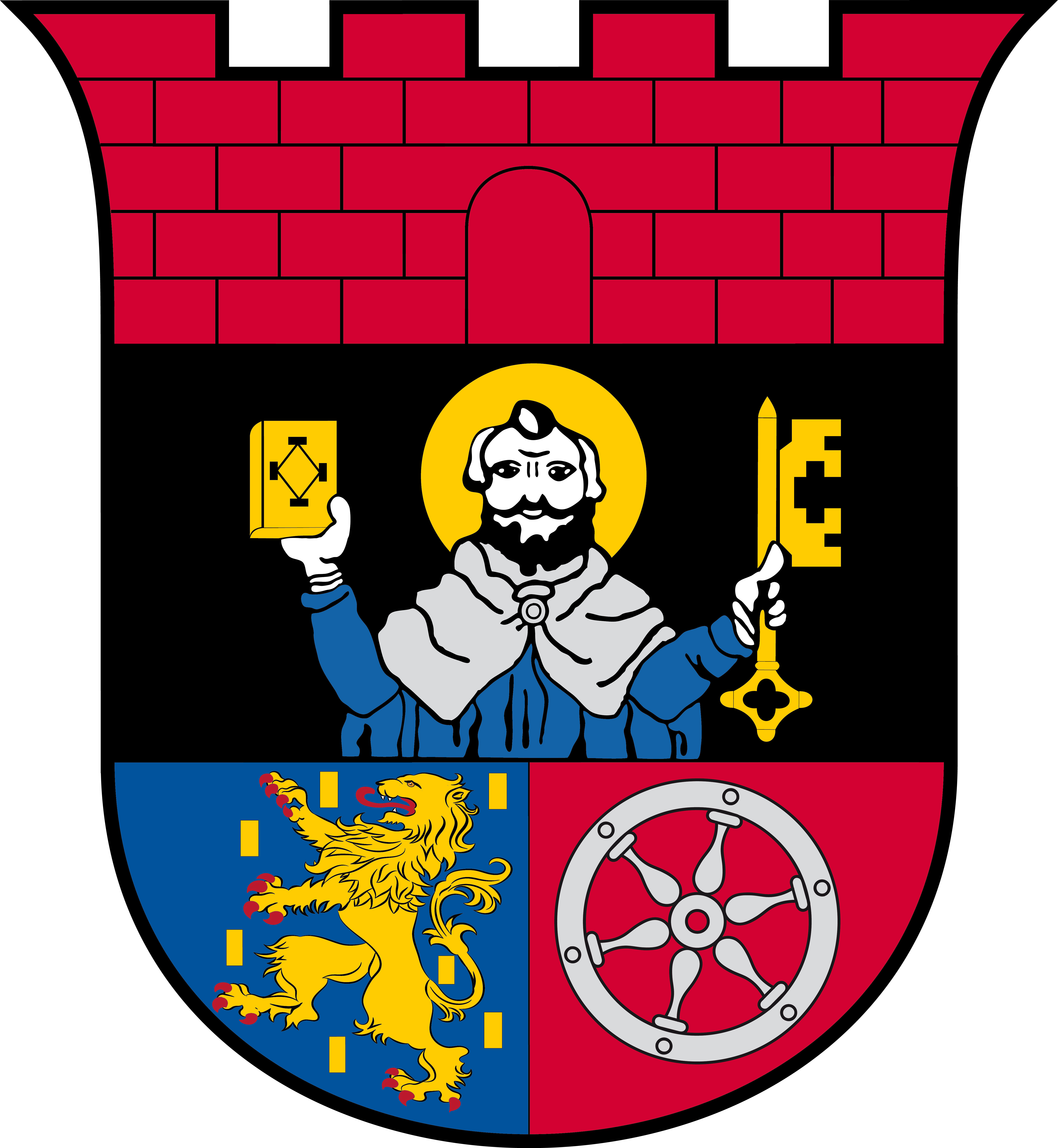
The coat of arms, officially approved in 1907 and granted in 1920, corresponds to the four oldest seals up to around 1700, the first of which appears soon after the granting of the town charter in 1352.
In the Hofheim town charter, main statute paragraph 6, version of 15.09.1993, the coat of arms of the town is described as follows:
"The town colors are blue, white and black. The U-shaped shield of the town's coat of arms, on which a mural crown is placed, is divided horizontally. The lower half shows in the left field on a blue background a rising lion, red-armed, between seven gold-colored shingles, in the right field on a red background a silver six-spoked wheel. In the upper half of the coat of arms, the figure of St. Peter appears against a black background, concealed up to chest height, in a silver upper and blue lower garment; in his right hand he holds a golden book, in his left a golden key. The use of the city coat of arms by third parties requires the approval of the magistrate."
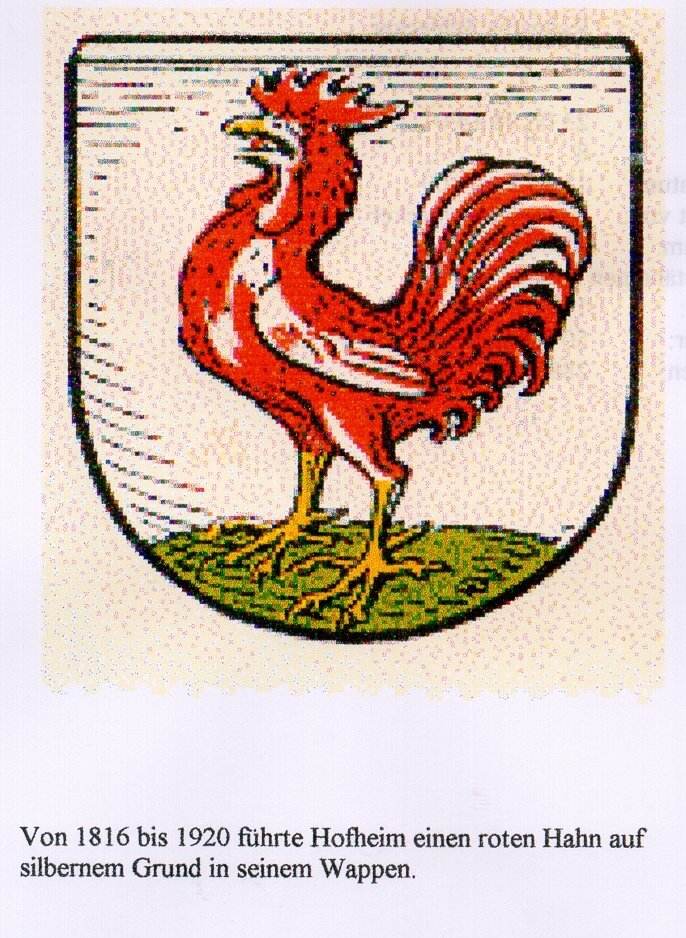
From 1816 to 1920, Hofheim had a red cockerel on a silver background in its coat of arms. This coat of arms was a consequence of the Imperial Deputation of 1803 and the political reorganization of the German states.
The Duchy of Nassau was created in 1806. According to paragraph 5 of the sovereign edict concerning the formation and administration of municipalities dated June 5, 1816, the use of coats of arms and municipalities was regulated. From then on, the mayor was allowed to use a seal with the coat of arms that had been used by the municipality up to that point or that was to be chosen by the entire local council and approved by the state government - before that, the old court seal had been used as a seal in Hofheim. With this decree, all old seals were withdrawn. The municipalities were free to choose the design of their coat of arms.
Hofheim chose the red cockerel as the "guardian of the city" and symbol for the patron saint Peter, patron saint of the city and patron saint of the church of St. Peter and Paul (see Matthew, 26.30-35 / prediction by Jesus, and Matthew, 26.69-75/actual event. When the cock crows, you will have denied me three times).
In 1905, the towns were asked by the Nassau state government to provide a depiction of their coat of arms. Hofheim responded by sending its red cockerel. In 1907, the Royal Prussian State Archives, which had been commissioned to examine the coats of arms, wrote back that the current town coat of arms had only been introduced in the 19th century, presumably arbitrarily, and pointed out that the town had demonstrably had a seal with a different, perfectly reasonable coat of arms at the end of the 14th century.
However, approval took until 1920, as this seal/coat of arms did not comply with heraldic considerations. It was not until then that the coat of arms as we know it today was officially introduced.
Sources:
Schlecker, Roswitha; Short chronicles, StadtmuseumStadtarchiv Hofheim 1994
Mauer, Karl Wilhelm; The coat of arms of the town of Hofheim, Hofheim 2009